

Natural vs. Chemical Cat Urine Odor Solutions
Cat urine odor is stubborn because of uric acid crystals that can linger for years, especially in porous surfaces. Choosing the right cleaning solution - natural or chemical - depends on your priorities: effectiveness, safety, and cost.
Key Takeaways:
- Natural Solutions: Vinegar, baking soda, and enzymatic cleaners are safer for pets and cost less (under $5 per use). They neutralize odors but take longer to work.
- Chemical Solutions: Oxidizers and synthetic enzyme cleaners act faster but may pose safety risks and cost $10+ per use. Avoid ammonia-based products as they encourage re-marking.
Quick Overview:
- Natural Remedies: Vinegar neutralizes alkaline salts; baking soda absorbs odors; enzymatic cleaners break down uric acid.
- Chemical Cleaners: Oxidizers remove odors quickly but can harm pets if misused. Fragranced cleaners often mask smells without fully removing them.
For pet-safe, budget-friendly cleaning, natural solutions are ideal. Chemical cleaners work faster but require caution. Below, we explore how each option tackles the problem and what to avoid.
How to Get Rid of Cat Pee Smell FOREVER (DIY Cleaning Guide for ALL Surfaces)
Why Cat Urine Odor Lasts So Long
Cat urine doesn’t just smell bad - it’s designed to linger. It’s a complex mix of urea, uric acid, creatinine, ammonia, bacteria, and hormones. While urea dissolves in water and washes away easily, uric acid is the real culprit. It forms tough, non-soluble crystals that cling to porous surfaces like carpets, wood, and upholstery, where they can stay embedded for years.
What makes uric acid so persistent? It acts as a desiccant, meaning it pulls moisture from the air. On humid days or when a humidifier is used, these crystals rehydrate, triggering bacterial growth and releasing that unmistakable stale smell all over again. This explains why the odor seems to reappear, no matter how much you’ve cleaned.
The smell itself goes through different stages. At first, bacteria break down the urea, releasing a sharp ammonia-like odor. Over time, the urine produces mercaptans, compounds responsible for a particularly strong and unpleasant smell. Interestingly, male cats emit significantly more 3-Mercapto-3-Methyl Butanol (MMB) - seven times more than females - resulting in an even stronger odor.
Standard cleaning solutions like vinegar, baking soda, or dish soap might help with the water-soluble parts of the urine, but they can’t break down those uric acid crystals. Dr. Melody R. Conklin, VMD, MBA, highlights this limitation:
Traditional household cleaners may help initially by cleaning and deodorizing the water-soluble elements in the urine, but without chemical breakdown of odor-causing molecules, a humid day will help uric acid crystals reform, and the smell will return.
It’s also crucial to avoid using heat on cat urine stains. Steam cleaners or hot water can permanently set the proteins into carpet fibers, making it nearly impossible to remove. Knowing how these odor mechanisms work is key to choosing the right natural or chemical solutions.
Natural Solutions for Cat Urine Odor
Using natural remedies to tackle cat urine odors is a safer choice for homes with pets and children. These methods steer clear of harsh chemicals that can release harmful fumes and help prevent cats from marking the same spot again. They work by neutralizing the alkaline salts in urine, absorbing moisture and smells, or breaking down the stubborn uric acid crystals responsible for lingering odors.
Vinegar and Baking Soda
Vinegar's natural acidity is great for neutralizing the alkaline salts found in dried cat urine stains, while baking soda excels at absorbing moisture and trapping unpleasant smells. This duo is a simple yet effective approach, especially for fresh stains or surface-level cleaning. However, it’s not as reliable for older or deeply set stains.
Here’s how to use it: Mix equal parts white vinegar and warm water, apply it to the stain, and blot the area dry. For carpets, sprinkle baking soda over the damp spot after cleaning, let it sit until fully dried, and vacuum thoroughly. If you're dealing with clothing, add either 1 cup of baking soda or 1/4 cup of vinegar to your regular wash cycle. Just avoid using a dryer or steam cleaner, as heat can lock the odor into the fabric permanently.
Enzymatic Cleaners
Enzymatic cleaners are often hailed as the most effective natural option. They contain proteins or live cultures that break down the compounds in urine, including stubborn uric acid crystals. These cleaners usually range in price from $13 to $42, and some professional-grade concentrates can last for years.
The secret to getting the best results with enzymatic cleaners is patience. Saturate the stained area thoroughly and let it air-dry completely. This gives the enzymes enough time to break down the urine components entirely. If you rinse or dry the spot too soon, the cleaner may not work as well.
Hydrogen Peroxide with Essential Oils
Hydrogen peroxide is an oxygen-based oxidizer that’s particularly good for tackling yellow stains and deep-seated odors. When paired with baking soda, it becomes even more effective. To use, sprinkle baking soda over the stain, then mix 3% hydrogen peroxide with a small amount of dish detergent and apply it. Always test hydrogen peroxide on a small, hidden area first, as it can cause discoloration on certain surfaces and fabrics.
For carpets, you can also create a natural herbal deodorizer. Mix 1 cup of dried herbs like rosemary or lavender with 1 teaspoon each of cloves, cinnamon, and baking soda. Sprinkle this mixture on the carpet, let it sit for a while, and then vacuum it up. This adds a pleasant scent while addressing odors.
Chemical Solutions for Cat Urine Odor
Chemical cleaners are often a go-to for tackling cat urine odors because they work quickly and effectively. However, they come with certain trade-offs, particularly when it comes to safety and environmental impact. Unlike natural remedies, these cleaners rely on strong oxidizers and synthetic enzymes, which break down odors rapidly but may pose health risks. They often combine these active ingredients with added fragrances to address both smells and stains.
Chlorine Dioxide Oxidizers
Chlorine dioxide and similar oxidizing agents target the sulfur compounds in cat urine, specifically thiols like 3M3MB, which are responsible for the strong, territorial spray odor. Studies indicate that N-halamine-modified granules, a type of chlorine-based oxidizer, can reduce thiol levels by 99.5% almost instantly. These oxidizers are especially effective on hard, non-porous surfaces, where they can be wiped clean after the urine is absorbed.
At low concentrations, such as 0.2%, chlorine-based oxidizers like MCDMH are considered safe for cats. However, there’s a critical safety warning: never use standard household bleach on cat urine. When bleach reacts with the ammonia found in urine, it produces chloramine gas, which is highly toxic and can cause severe respiratory issues for both humans and pets. This makes specialized chemical cleaners a safer option for odor removal.
Enzyme and Fragranced Cleaners
Another category of chemical cleaners uses synthetic enzymes combined with fragrances. These enzymes work by breaking down the organic components of urine. However, while the added fragrances can make the area smell fresh initially, they may only mask odors. If uric acid crystals remain, the smell can reappear under humid conditions.
It’s important to avoid ammonia-based cleaners entirely. Since ammonia resembles the scent of urine, using these products can confuse cats and encourage repeat marking. Additionally, ammonia-based cleaners often leave residues that require thorough rinsing to remove.
sbb-itb-861ee2e
Natural vs. Chemical Solutions: Side-by-Side Comparison
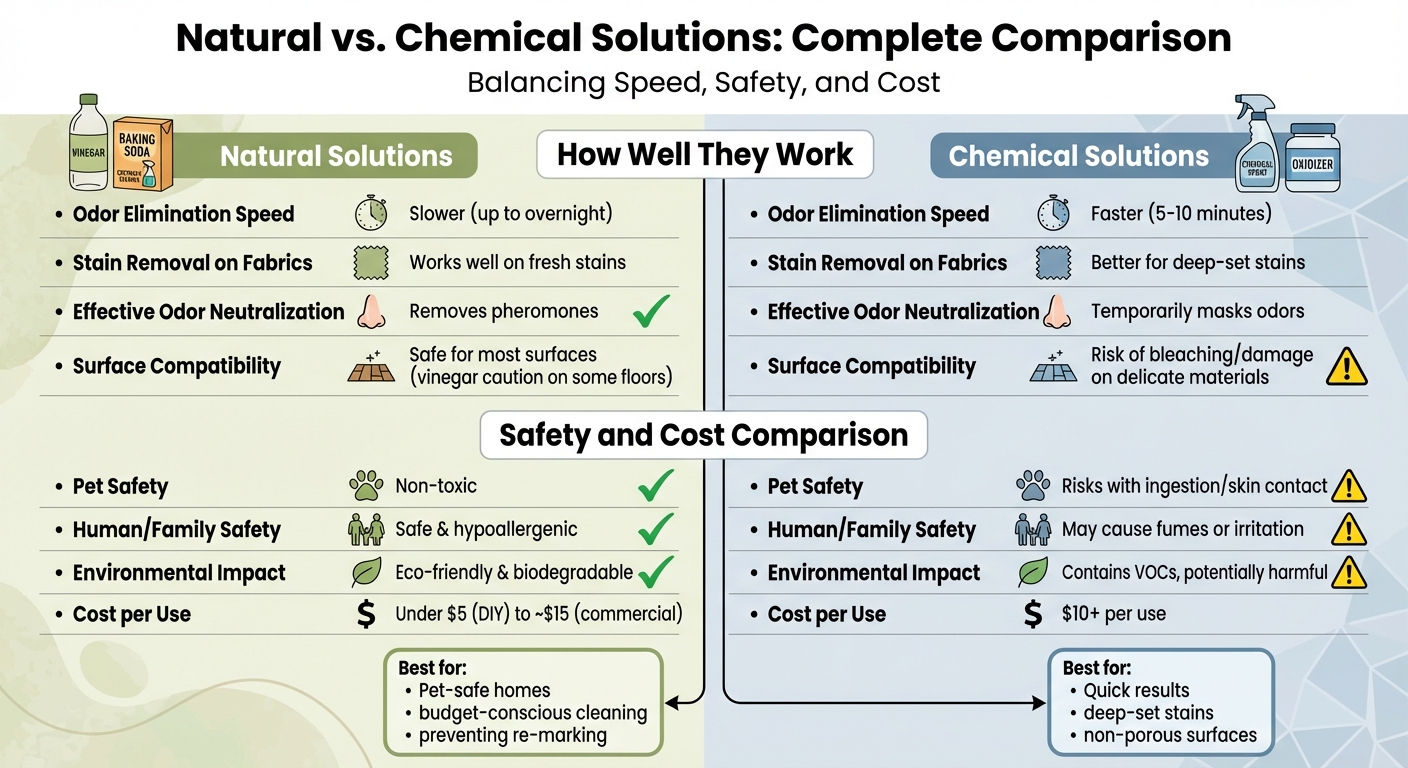
Natural vs Chemical Cat Urine Odor Solutions Comparison Chart
When choosing between natural and chemical solutions, it's all about balancing speed, safety, and cost. Each option comes with its own strengths and trade-offs, especially when it comes to performance and household safety.
How Well They Work
Natural solutions, like enzymatic cleaners, take a bit more time but thoroughly neutralize odors. For example, enzymatic cleaners usually need about 10–15 minutes to break down uric acid. On the other hand, chemical oxidizers work much faster, often taking just 5–10 minutes to show results.
One key difference lies in how they handle odors. Enzymatic cleaners go the extra mile by eliminating pheromones, which prevents pets from re-marking the same spot. Chemical cleaners, however, tend to mask the odors temporarily instead of addressing the root cause.
Here’s a quick breakdown of how they compare:
| Factor | Natural Solutions | Chemical Solutions |
|---|---|---|
| Odor Elimination Speed | Slower (up to overnight) | Faster (5–10 minutes) |
| Stain Removal on Fabrics | Works well on fresh stains | Better for deep-set stains |
| Effective Odor Neutralization | Removes pheromones | Temporarily masks odors |
| Surface Compatibility | Safe for most; vinegar can harm some floors | Risk of bleaching or damage to delicate materials |
Safety and Cost Comparison
Performance aside, safety and cost are key considerations when deciding which solution is right for your home.
Natural solutions are generally non-toxic and biodegradable, making them a safer pick for households with kids and pets. For example, vinegar and baking soda are popular DIY options that are safe to use around the family. Chemical cleaners, however, can produce harmful fumes or cause skin irritation, especially in spaces with poor ventilation. According to the Environmental Working Group, some chemical products are rated lower due to their VOC (volatile organic compound) content, which can impact air quality.
When it comes to cost, natural DIY methods like vinegar and baking soda are budget-friendly, often costing less than $5 per use. However, they may not fully break down uric acid, which can lead to repeated marking and higher costs in the long run. Commercial enzymatic cleaners, priced between $10 and $20 per bottle, are more effective in preventing re-soiling. Meanwhile, chemical cleaners can cost $10 or more per use and might require multiple applications to achieve desired results.
Here’s a closer look at the safety and cost factors:
| Factor | Natural Solutions | Chemical Solutions |
|---|---|---|
| Pet Safety | Non-toxic | Risks with ingestion or skin contact |
| Human/Family Safety | Safe and hypoallergenic | May cause fumes or irritation |
| Environmental Impact | Eco-friendly and biodegradable | Contains VOCs, potentially harmful |
| Cost per Use | Under $5 (DIY) to around $15 (commercial) | $10+ per use |
How to Apply Natural and Chemical Solutions
Getting rid of odors effectively starts with proper liquid extraction and thorough cleaning. If you're dealing with fresh urine, blot the area with paper towels - don’t scrub! Scrubbing only pushes the liquid deeper into the fibers. After blotting, rinse the spot with cool water and use a wet/dry vacuum to pull out as much liquid as possible. Avoid using a steam cleaner - the heat can lock urine proteins into the fibers, making the smell harder to remove.
Once you've removed the liquid, it's time for targeted treatments. If you're using a natural enzymatic cleaner, make sure to saturate the entire stained area, including any carpet padding or cushion stuffing beneath the surface. This ensures the cleaner reaches every bit of the urine. Let the solution sit for 10–15 minutes, then blot it with clean towels. As C.S. Friedman explains:
The stuff [enzymatic cleaner] will keep working as long as it is damp and there is urine for it to eat.
To protect the treated area while it dries, cover it to avoid interference. For mattresses or cushions, place towels over the spot and replace them daily until the area is completely dry. This approach not only eliminates odors but also helps deter pets from marking the same spot again by fully neutralizing the smell.
For chemical cleaners, the process is similar but often faster. After blotting and rinsing, apply the chemical cleaner as directed - usually leaving it on for 10–15 minutes. Keep pets away from the area until it’s fully dry. And remember, never mix bleach with urine; the combination can release toxic gases.
If you’re using vinegar and baking soda, follow the same basic steps for fabrics or hard surfaces. For unsealed hardwood floors, apply white vinegar, let it sit for a few minutes, then wipe it clean. Be sure to dry the area immediately to avoid damaging the wood.
Stay away from ammonia-based cleaners - they can mimic the smell of urine and encourage pets to re-mark the area. For laundry, rinse urine-soaked items in cool water, then add one cup of baking soda or 1/4 cup of vinegar to the wash cycle. Always air-dry these items - using a dryer can lock in any lingering odors permanently.
When to Use Natural Solutions Instead of Chemical
Natural cleaning solutions are a smart choice, especially when the safety of your pets is a concern. Cats are notorious groomers, meaning any chemical residue left on floors or furniture can end up being ingested. Even some "natural-style" cleaners, like those containing orange essential oils, can be harmful to cats if consumed. Instead, safer alternatives like vinegar, baking soda, and enzymatic cleaners get the job done without posing a risk.
Respiratory health is another compelling reason to steer clear of chemical cleaners. Many conventional urine removers are packed with synthetic fragrances, which can irritate the lungs of both humans and cats. If anyone in your home has respiratory issues, switching to natural options can help maintain a healthier environment while still effectively tackling messes. Plus, these natural remedies can discourage repeat accidents, making them doubly useful.
From an odor perspective, natural solutions shine by preventing re-marking. Ammonia-based commercial cleaners can confuse cats, prompting them to mark the same spot repeatedly. Vinegar, on the other hand, neutralizes the alkaline salts found in dried urine, eliminating the scent cues that might mislead your cat into thinking the area is a litter box.
Cost is another area where natural solutions come out ahead. Household staples like white vinegar and baking soda are incredibly affordable, costing just pennies per use. Compare that to commercial enzymatic cleaners, which can run about $12.72 for a 32-ounce bottle. Even for laundry, you can skip pricey specialty detergents by adding one cup of baking soda or 1/4 cup of vinegar to your wash cycle - perfect for dealing with urine-soaked bedding.
Finally, natural solutions are especially effective for cleaning hard surfaces and handling emergency messes. For quick cleanup jobs, a simple 1:1 mix of white vinegar and water works wonders on sealed wood floors and walls. It not only cleans effectively but also avoids leaving slippery residues or setting stains.
Conclusion
Dealing with cat urine odor doesn’t have to mean turning to harsh chemical cleaners. Natural solutions like vinegar, baking soda, and enzymatic cleaners offer a safer, more effective, and budget-friendly way to tackle odors at their source. Unlike chemical products that may release harmful fumes or contain ammonia, these natural options get the job done without risking your pet’s health.
Enzymatic cleaners, in particular, are a standout choice. They go beyond masking smells by breaking down uric acid crystals, ensuring the odor is gone for good. Plus, they avoid synthetic irritants that could affect both human and feline respiratory systems. On top of that, these natural solutions are kind to the environment, thanks to their biodegradable ingredients that don’t harm the planet.
This philosophy of chemical-free care extends beyond cleaning. For example, catandogs.shop champions safer pet care with products like the CatanDog's Medal. Using bio-resonance technology, it provides flea and tick protection without exposing pets to harsh chemicals - a win for both your furry friends and your peace of mind.
Whether you’re addressing a fresh mishap or tackling lingering odors, natural solutions offer an affordable and effective way to keep your home clean and your pets safe. Household staples like white vinegar and baking soda cost less than $5 per use, making them a practical choice for any pet owner. By choosing natural methods, you’re not just removing odors - you’re creating a healthier, happier environment for every member of your family, both human and animal.
FAQs
How do natural remedies like vinegar and baking soda remove cat urine odors?
Natural solutions like vinegar and baking soda are effective at tackling the unpleasant odors caused by cat urine. Vinegar, known for its acidic nature, works by breaking down alkaline substances such as ammonia - the primary culprit behind that strong smell. On top of that, it slows down bacterial growth, which helps keep the odor from getting worse over time.
Baking soda, on the other hand, acts as a natural deodorizer. It not only absorbs odors but also reacts with both acidic and basic elements in the urine, neutralizing them effectively. When you combine baking soda with vinegar, the fizzing reaction that occurs helps lift those odor-causing particles right off surfaces. These remedies are safe, budget-friendly, and kind to the environment, which is why many pet owners swear by them for keeping their homes fresh and odor-free.
Are chemical cleaners safe for removing cat urine odors?
Chemical cleaners designed to tackle cat urine odors can be risky if not handled properly. Many of these products include harsh disinfectants or synthetic chemicals that might harm pets or humans if accidentally ingested, inhaled, or absorbed through the skin. In some cases, they can even cause respiratory issues or skin irritation, particularly in spaces with poor ventilation.
Beyond health concerns, certain cleaners might damage household surfaces or leave behind unpleasant, lingering smells. To avoid these problems, you might want to try natural options like white vinegar, baking soda, or enzyme-based cleaners. These alternatives tend to be gentler on pets and better for the environment. Whatever product you choose, make sure to carefully read the label and follow the instructions to use it safely.
Why shouldn’t you use heat to clean cat urine stains?
Using heat to tackle cat urine stains might seem like a quick fix, but it can actually backfire. Heat can cause the odor and stain to sink deeper into surfaces, making them even tougher to remove. Instead, opt for cleaning products specifically designed to break down the compounds in cat urine. These solutions are both effective and safe for addressing the issue without making it worse.